
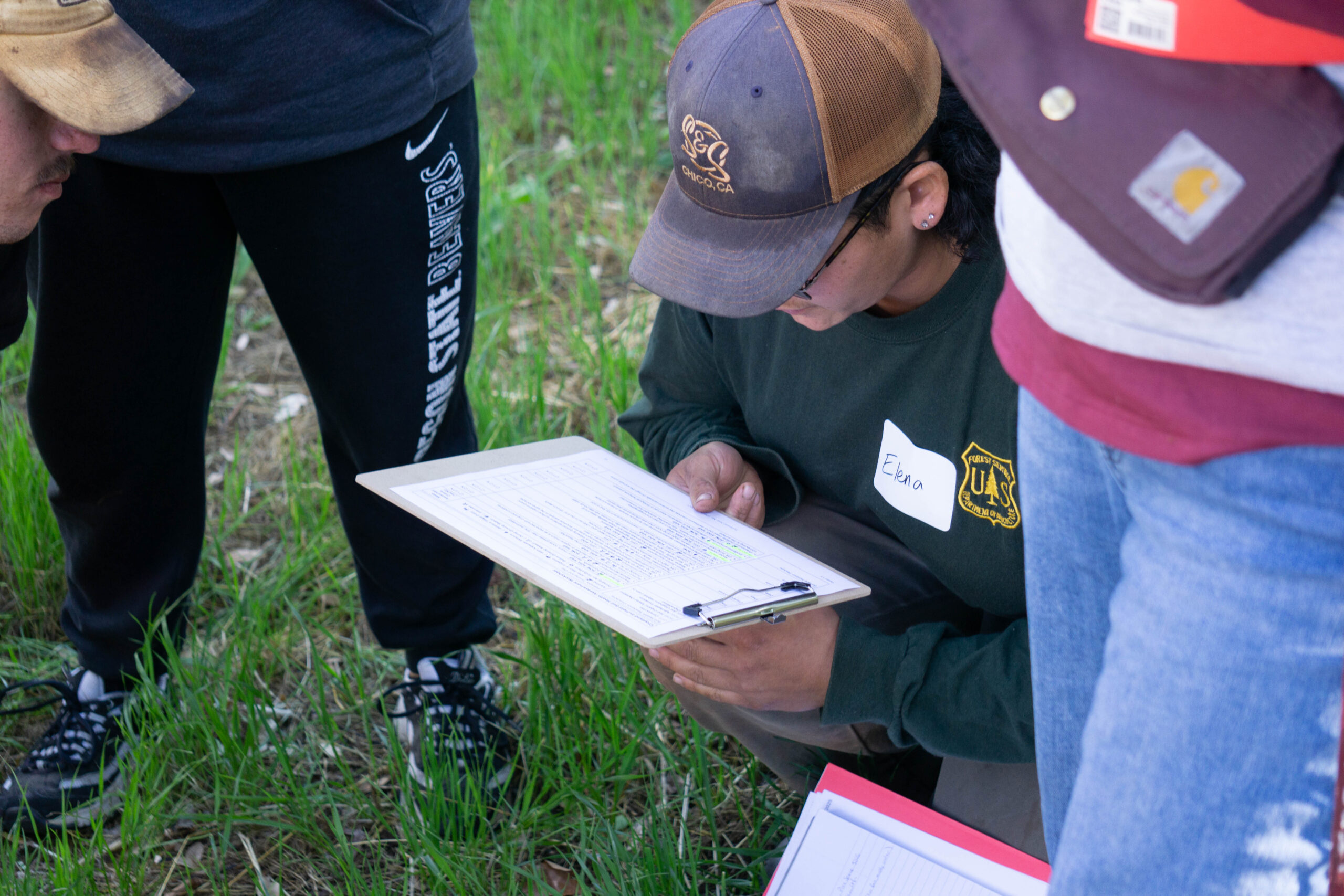
 Participants of a soil health and erosion workshop learning the basics of soil health and texture analysis.
On May 13, 2025, local farmers and ranchers gathered at Stock Family Orchard, just outside Newcastle, California, for an evening field training on soil health and erosion control. The event was hosted by Sierra Harvest and facilitated by Placer RCD.
Set along an unnamed tributary to Auburn Ravine, with its shoulders still green—the training took place in the Upper Coon–Upper Auburn Watershed, on the edge of an olive orchard. The peaceful evening setting, complete with a nearby pond and a shaded gathering area, offered more than just technical insight. Thanks to orchard owner Peggy Stock, guests were welcomed with fresh, locally produced olive oil, cheese, and crackers.
But there was another story to be told in the soil.
Once riddled by rill erosion, the orchard had undergone a dramatic transformation. Months earlier, Placer RCD Conservation Planner Mark White and Agriculture Program Manager, Brian Pimentel, had developed a customized conservation plan for the site, which was selected to be funded through the Environmental Quality Incentives Program (EQIP). Peggy and her team implemented it with care and precision. The result? A living example of land recovery: a new chance at improved soil structure, rising organic matter, better water infiltration and retention, and a steep reduction in erosion.
Inspired by the success, Placer RCD and Sierra Harvest invited the Stock Family to host this on-site training, turning their orchard into a living classroom for the evening and model for land care.
The training focused on erosion control and core principles of soil health: minimizing soil disturbance, maximizing biodiversity, maintaining soil cover, and keeping living roots in the ground year-round—all of which are now integrated into the management of Stock Family Orchard. And participants got their hands dirty by performing in-the-field soil analysis.
Before partnering with Placer RCD NRCS’ EQIP Program, stewardship at the orchard was guided by more conventional expectations—namely, maintaining a “clean” orchard floor. While that approach may be common in flatter or less erosion-prone regions, it poses erosion risk in the Sierra Foothills. With steep slopes and fragile soil structure, exposed ground can quickly lead to rill erosion.
The pictures below illustrate the positive transformation that took place:


The evening wrapped with thoughtful conversation, new connections, and a shared sense of possibility. For many attendees, seeing erosion recovery in action and hearing directly from the landowner brought the principles of soil health to life in a tangible, relatable way. Stock Family Orchard stands as a powerful reminder that even long-standing practices can evolve, and that with the right support, stewardship can be both practical and transformative.
Placer RCD’s time at the Stock Family Orchard was supported by CDFA Climate Smart Agriculture – Technical Assistance Grant.
For questions regarding technical and or financial assistance on soil health, please contact:
-
Brian Pimentel
Agriculture Program Manager
-
Mark White
Conservation Planner


